Bring these inputs
- Owner specification and business decision
- Installed-system inventory and available drawings
- Retained interfaces, operating constraints and outage windows
- Bid assumptions, supplier offers and known information gaps

EPC scope discussion · Illustrative sample
Turn an owner requirement into a reviewable scope: a requirements register, an architecture boundary and a responsibility matrix.
Before you use the samples
Collaborative Systems Integration (CSI) helps EPC teams review O-PAS requirements, define architecture and supplier boundaries, and plan integration and acceptance work. These samples show the form of those outputs; the project team agrees the actual content, responsibilities and commercial scope.
The scenario is an early planning review for a proposed OPA subsystem at an existing facility. No product, supplier, O-PAS edition or profile has been selected. No design, test result, saving or acceptance decision is implied.
Sample 01
Each entry connects a proposed requirement to a question, an evidence item and a decision owner. All four entries are illustrative and open.
| Record | Proposed requirement | Clarification and evidence | Decision owner and gate |
|---|---|---|---|
| R-01 Requirement basis | The proposed subsystem uses an agreed O-PAS requirement basis. | Identify the applicable edition, profiles, project exceptions and exact product/version evidence. Record these in the design basis; do not accept an unqualified “O-PAS compliant” statement. | Owner technical authority, with EPC review. Open: resolve before supplier selection. |
| R-02 Retained interface | Required information is exchanged with retained plant systems. | Confirm data and command direction, protocol, security boundary, quality and failure behavior. Obtain the retained-system interface specification and assign interface ownership. | Owner and EPC nominate the interface decision owner. Open: resolve before architecture freeze. |
| R-03 Recovery | The subsystem meets the owner's operating and recovery needs. | Agree allowable interruption, recovery behavior, degraded operation and test conditions. Define measurable acceptance criteria in an approved verification plan. | Owner operations and technical authority. Open: resolve before test scope and price are frozen. |
| R-04 System accountability | One named party coordinates integrated system performance. | Name the integration authority and allocate diagnosis, correction, retest, configuration and handover obligations in the contract responsibility matrix. | Owner and EPC commercial and technical leads. Open: resolve before contract award. |
A row closes only when its decision, supporting evidence and approval are recorded. A proposed requirement is not an approved design instruction.
Sample 02
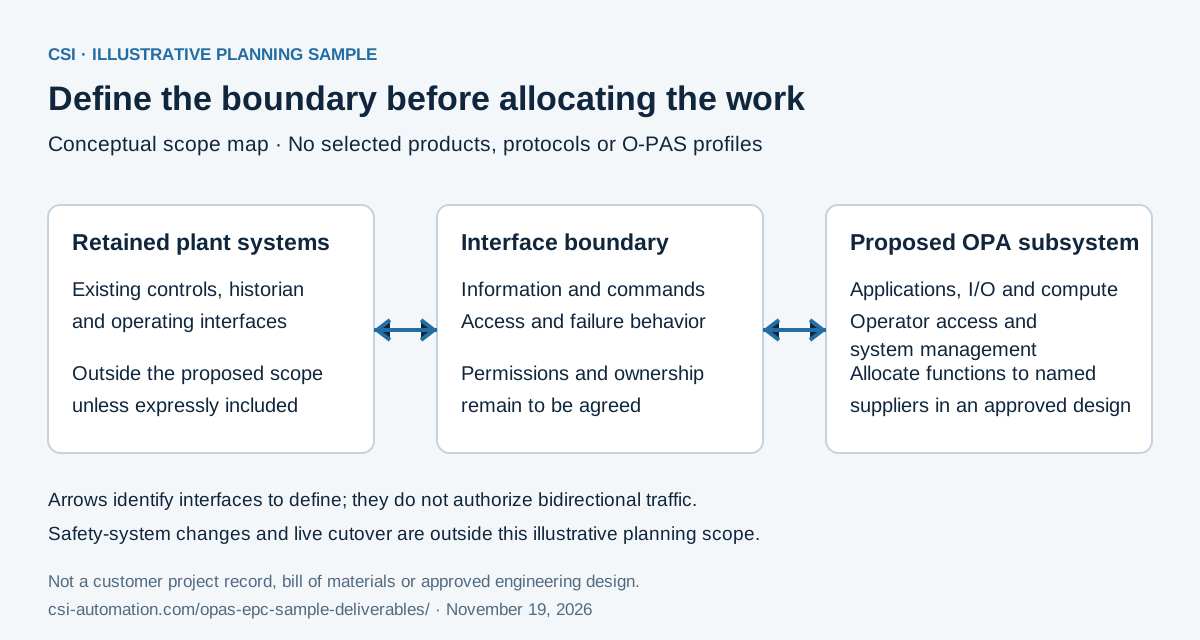
This is a conceptual boundary map, not a network design or a proposed bill of materials.
Existing controls, historian and operating interfaces remain outside the proposed subsystem scope unless expressly included.
Agree information, commands, access, failure behavior and change ownership. Protocols and products remain to be selected.
Allocate control applications, I/O, compute, operator access and system management to named suppliers in the approved design.
Boundary decisions still required: cybersecurity zones and access, availability, safety-system separation, interface permissions and deployment responsibility. The arrows identify interfaces to define; they do not authorize bidirectional traffic. Safety-system changes and live cutover are outside this illustrative planning scope.
Sample 03
Example allocation for discussion. Replace every role with an agreed organization, named authority and contractual obligation; this table assigns no real project contract.
| Work item | Prepare or coordinate | Approve or accept | Resolve before award |
|---|---|---|---|
| Requirements and architecture basis | EPC engineering, with CSI specialist support if contracted | Owner technical authority | Applicable requirements, evidence, exceptions and interface boundaries |
| Integrated configuration and supplier interfaces | Named integration authority, with assigned supplier obligations | Named project design authority, subject to owner acceptance requirements | Who holds system accountability, controls versions and coordinates correction |
| FAT evidence, correction and retest | Named integration authority coordinates; suppliers perform assigned tests and corrections | Acceptance authority named in the approved test plan | Witness points, pass criteria, evidence ownership and included retest effort |
| Site work and operating handover | Separately contracted site delivery and integration parties | Owner operations and designated acceptance authority | Site scope, operating authority, handover assets and ongoing support |
CSI's participation in planning does not automatically assign it prime integration, site execution or lifecycle-support accountability. Those roles require a separately agreed scope. See the O-PAS Responsibility Matrix guide.
Actual project evidence
At ExxonMobil's Anchorage Chemical Terminal, CSI designed the COPA 500 system and collaborated on implementation. Wood led system integration and project execution; CPLANE supplied Fusion orchestration. ACT automated a previously manual brownfield facility; it was not a legacy-DCS replacement.
That project account supports these specific contributions. The samples above are new illustrative planning material, not ACT drawings, contracts or acceptance records.
Bring your owner specification, project phase and unresolved decisions. Agree the inputs, outputs, review participants, exclusions, schedule and commercial terms before work begins.